Pearson Edexcel · GCSE · Psychology
Course version: 1PS0 · Version from Sept 2017
Perception - 8.2 Studies: *8.2.2 Carmichael, Hogan and Walter (1932) An…
Full specification wording
Topic 8: Perception - 8.2 Studies: *8.2.2 Carmichael, Hogan and Walter (1932) An Experimental Study on the Effect of Language on the Reproduction of Visually Perceived Form
This study investigated whether language affects how we remember and reproduce visually perceived forms.
Checked against the Pearson Edexcel 1PS0 specification (opens in a new tab) on .
- Point 2 of 2
- 3 key terms
Study notes
From the checked teaching notes for this specification point.
The idea
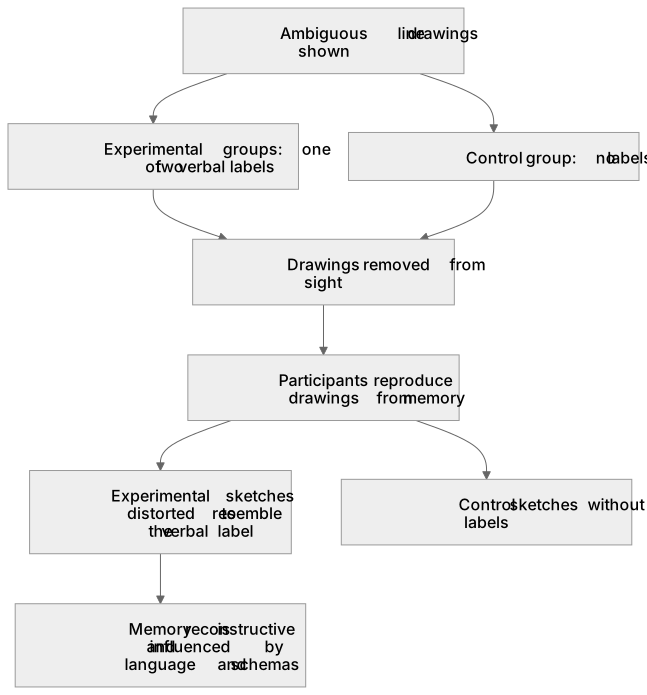
This study investigated whether language affects how we remember and reproduce visually perceived forms. Participants were shown ambiguous line drawings (e.g., two circles connected by a line) alongside one of two different verbal labels (e.g., "eyeglasses" or "dumbbells"). A control group saw the drawings without labels. When asked to reproduce the drawings from memory, participants' sketches were significantly distorted to resemble the verbal label they had been given. This demonstrated that memory is reconstructive and heavily influenced by language and prior knowledge, supporting the idea that perception and memory are not just passive recordings but active processes shaped by cognitive schemas.
What earns the marks
- Identify the aim: to see if verbal labels affect the reproduction of visual forms.
- Describe the procedure: participants were shown ambiguous figures with one of two word lists, or no words for the control group.
- State the findings: drawings were distorted to match the verbal label provided.
- Explain the conclusion: memory is reconstructive and influenced by language and schemas.
Common mistakes and how to put them right
Thinking the study investigated how well participants could draw.
Put it right: The study investigated how verbal labels influenced memory reconstruction, not drawing ability.
Confusing the control group with the experimental groups.
Put it right: The control group received no verbal labels, whereas the experimental groups received one of two different lists of labels.
Believing participants copied the drawings while looking at them.
Put it right: Participants reproduced the drawings from memory after they had been removed from sight.
Exam tips
- Memorise specific examples of the ambiguous figures and their two labels, such as the "eyeglasses" versus "dumbbells" example.
- Be prepared to link the findings of this study to the broader concept of reconstructive memory and schemas.
- When evaluating the study, consider its artificial nature (low ecological validity) as participants were asked to remember abstract line drawings.
Try the lesson
The start of the Topic 8: Perception - 8.2 Studies: *8.2.2 Carmichael, Hogan and Walter (1932) An Experimental Study on the Effect of Language on the Reproduction of Visually Perceived Form lesson, made from checked teaching notes for this specification point.
Have a go first
What was the independent variable in Carmichael, Hogan and Walter's (1932) study on the reproduction of visual forms?
Listen
This study investigated whether language affects how we remember and reproduce visually perceived forms. Participants were shown ambiguous line drawings (e.g., two circles connected by a line) alongside one of two different verbal labels (e.g., "eyeglasses" or "dumbbells"). A control group saw the drawings without labels. When asked to reproduce the drawings from memory, participants' sketches were significantly distorted to resemble the verbal label they had been given. This demonstrated that memory is reconstructive and heavily influenced by language and prior knowledge, supporting the idea that perception and memory are not just passive recordings but active processes shaped by cognitive schemas. A strong answer earns marks for these points. Identify the aim: to see if verbal labels affect the reproduction of visual forms. Describe the procedure: participants were shown ambiguous figures with one of two word lists, or no words for the control group. State the findings: drawings were distorted to match the verbal label provided. Explain the conclusion: memory is reconstructive and influenced by language and schemas. A common slip: Thinking the study investigated how well participants could draw. Instead, The study investigated how verbal labels influenced memory reconstruction, not drawing ability. Exam tip: Memorise specific examples of the ambiguous figures and their two labels, such as the "eyeglasses" versus "dumbbells" example.
See it
Key words
Say what each word means before you turn the card.
Reconstructive memory
Try answering aloud or in your head before turning the card.
Influence of language
Try answering aloud or in your head before turning the card.
Cognitive schemas
Try answering aloud or in your head before turning the card.
See every definition
- Reconstructive memory
- The idea that memory is not a passive recording but an active process, so that what is remembered is shaped by language and prior knowledge.
- Influence of language
- The effect of verbal labels on how visually perceived forms are remembered and reproduced, so that sketches are distorted to resemble the label given.
- Cognitive schemas
- Prior knowledge that shapes perception and memory, supporting the idea that these are active processes rather than passive recordings.
Label the diagram
Some boxes have lost their names. Pick the right name for each number.
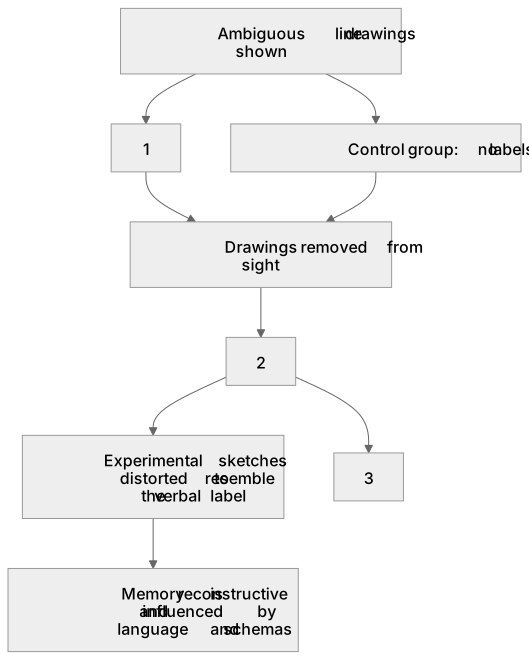
1Box 1
2Box 2
3Box 3
There is more to this lesson
The full lesson goes on to check your understanding and help you earn the marks. Create a free account to carry on, with your progress saved.
A week of Premium from your first lesson · Then the free plan continues · No card, no charge
Test your understanding of Topic 8: Perception - 8.2 Studies: *8.2.2 Carmichael, Hogan and Walter (1932) An Experimental Study on the Effect of Language on the Reproduction of Visually Perceived Form
Active recall beats re-reading. Take an instant quiz now to test what you’ve learned and lock it into long-term memory.
A week of Premium from your first lesson · Then the free plan continues · No card, no charge